Someone has asked you for a VPAT. Maybe a buyer put it in a solicitation, or a customer’s procurement team sent an email with a deadline attached. Either way, you now need to produce a document you have never seen.
This article covers what a VPAT is, which of the four templates you need, and what a filled-in one looks like. It then gets to who actually asks for one, what the law requires, how to produce one, and how often to redo it.
Key points
- A VPAT is ITI’s blank template. Fill it in for one product, and it becomes an Accessibility Conformance Report, or ACR. That completed VPAT is the document buyers read.
- The current version is VPAT 2.5Rev, released April 2025, in four editions. If you sell to US federal agencies, you must use the Revised Section 508 or the International edition.
- The templates are free Word files. There is no registration, no fee, and no membership requirement.
- Only Levels A and AA of WCAG are required for a report meant to inform US federal procurement.
- No law requires you to produce an ACR. Section 508 obliges federal agencies, who may accept “other evidence of accessibility testing”, but a federal solicitation will usually require a complete ACR for your bid to be considered.
- Nobody certifies an ACR. ITI does not review them, and there is no pass or fail rating, which is why section508.gov tells buying agencies to “trust but verify”.
What is a VPAT?
VPAT, or Voluntary Product Accessibility Template, is a document a product developer or vendor prepares to describe how well their product conforms to accessibility standards.
The Information Technology Industry Council, a trade association usually shortened to ITI, publishes the template and still maintains it. It is free to download, and the current version is VPAT 2.5Rev, released in April 2025.
Strictly speaking, the VPAT is only the blank form. You download it, fill it in for one product at one version, and what you are left with has a different name.
ITI puts it plainly: “Once the VPAT is completed for a specific product or service, the finished document is called an Accessibility Conformance Report or ACR.”
In everyday use, the line blurs. The phrase “VPAT report” is a contradiction on paper, because the report is the ACR. People say it constantly all the same, and in a procurement email they almost always mean the completed document.
If you need to settle which artifact someone is asking you for, the difference between a VPAT and an ACR sorts out which one to ask for.
For the rest of this page, VPAT means the template and the work of filling it in.
Which VPAT template do you need?
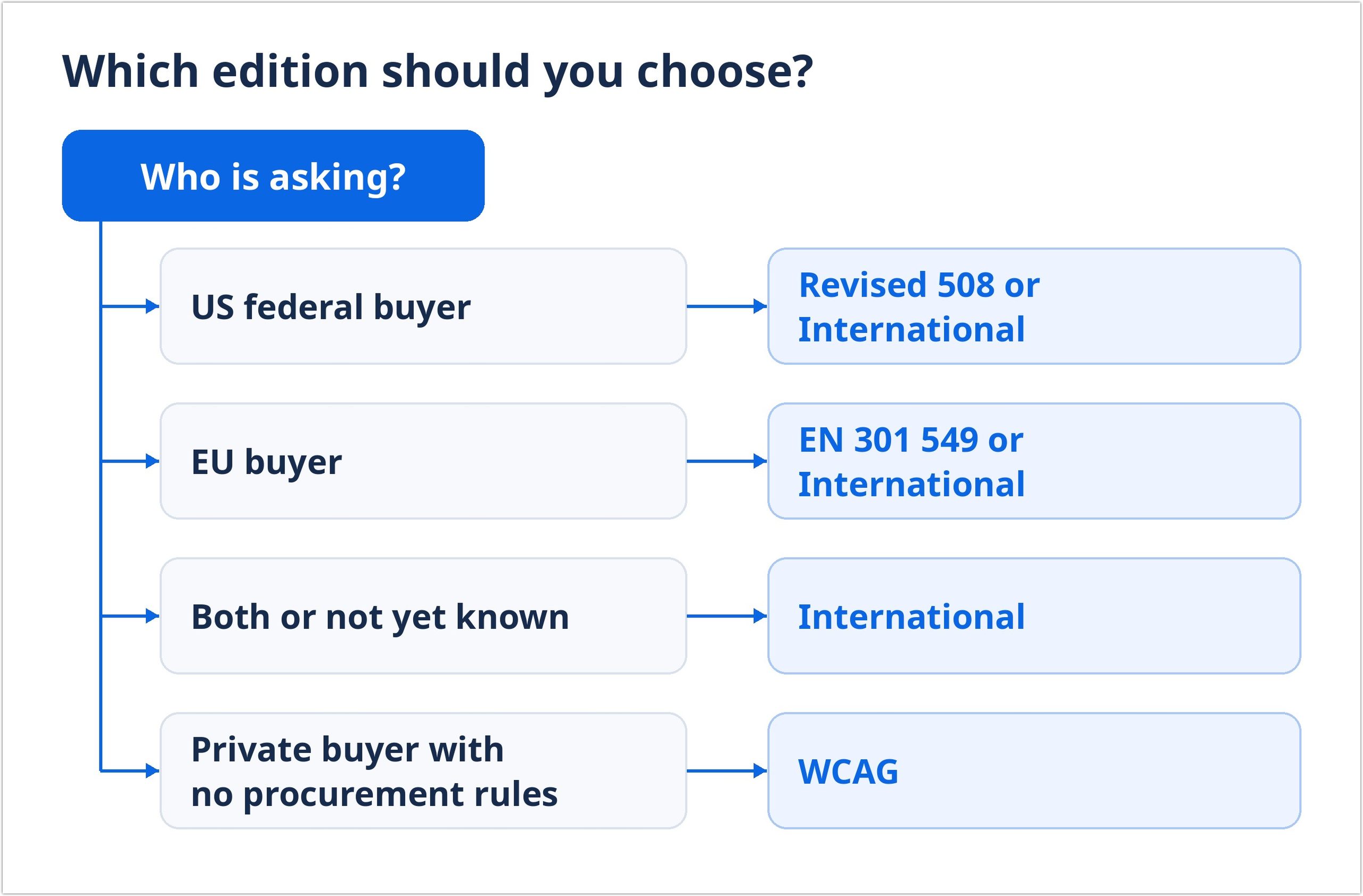
The one that matches the standards your buyers measure against. ITI publishes four versions of the blank template, and they differ only in which standards the tables cover.
All four cover WCAG, the Web Content Accessibility Guidelines. Two of them add a national rulebook on top: the Revised Section 508 standards are the US federal accessibility requirements, and EN 301 549 is the European equivalent.
| Edition | Standards covered | Use it when |
|---|---|---|
| WCAG | WCAG 2.0, 2.1 and 2.2 | Your buyers only care about web content accessibility, with no procurement rules attached. |
| Revised Section 508 | WCAG 2.0 and the Revised Section 508 standards | You are selling to US federal agencies and need nothing else. |
| EN 301 549 | WCAG plus the European EN 301 549 standard | Your buyers are in the EU and are measuring against the European standard. |
| International (INT) | All of the above in one document | You sell into more than one of those markets, or you do not yet know which buyer will ask. |
For US federal work, the choice is constrained. Section508.gov states that sellers to the federal government “must use the Revised Section 508 or the INT International Editions of the template.”
If you only ever produce one report, the International edition is usually the safe pick. It is longer, but it answers a European buyer and an American one from the same document.
All four are free, and you download them as Word files from ITI’s VPAT page. There is no registration and no membership requirement.
What does a filled-in VPAT look like?
Every completed report has the same four parts, whichever edition it is built from.
| Part | What it holds |
|---|---|
| Product information | The company name, the product name and its version, the report date, a short description, and a contact for accessibility questions |
| Evaluation methods | How the product was tested: which assistive technologies, which automated tools, which manual techniques |
| Applicable standards | Which standards the report covers, which follows from the edition used |
| Conformance tables | One row per success criterion, each carrying a verdict and a remark |
The conformance tables are the bulk of the document. Each row covers one success criterion and takes one of five fixed verdicts: Supports, Partially Supports, Does Not Support, Not Applicable and Not Evaluated.
Beside the verdict sits a remark, and that is where a reader finds out what the verdict actually refers to. Here is one row from a published report.
Adobe’s Accessibility Conformance Report for Acrobat Web is dated April 2025 and uses the International edition. Adobe publishes it openly, so anyone can check the row below against the source.
| Criteria | Conformance Level | Remarks and Explanations |
|---|---|---|
| 1.1.1 Non-text Content (Level A) | Web: Partially Supports | The product provides sufficient text alternatives for most instances of non-text content, such as informative images. Exceptions include: some images do not have a text alternative, so people who are blind and/or use a screen reader will not be able to access the information available in the image. This occurs on the following pages: Anonymous Modern Viewer; File Viewer: PDF; Request eSignatures (Send); Acrobat Web Paywall; Welcome Page. |
The criterion on the left is 1.1.1 Non-text Content, a published WCAG success criterion. So the row is a claim against a standard anyone can look up, not Adobe’s own definition of accessible.
The remark on the right names five specific pages. That is what lets a buyer check the claim and a developer open a ticket from it.
The remark is condensed here, and the published row runs longer. The guide to the accessibility conformance report takes a finished document apart in full, verdict by verdict.
Is there a VPAT certification?
No. There is no certificate, no accreditation, and no pass mark, because an ACR is written by the people who make the product. ITI does not check it: “ITI develops and maintains the VPAT template but does not review, approve or certify completed VPATs or ACRs.”
ITI says the same about the finished report: “There is no official VPAT or ACR certification, approval or pass/fail rating.” Third-party review is possible, and some buyers insist on it, but it is not built into the process.
This is not a reason to distrust the documents. It is a reason to read them as a claim with evidence attached, and to check the evidence.
The US government takes the same view of its own suppliers. Section508.gov tells buying agencies, “Trust but verify: before awarding a contract or deploying custom-developed deliverables, conduct accessibility testing,” and says that testing should happen regardless of the source of the software.
So if you are the vendor, expect a buyer to check some of your claims against the product itself. The rows covering whatever they plan to use the product for are where they will start.
Who needs a VPAT, and is it required by law?
If you sell software to US federal agencies, universities, state bodies, or large enterprises, you will be asked for one. But no law requires you, as a vendor, to produce a VPAT or an ACR, and the distinction is worth getting right.
Section 508 of the Rehabilitation Act puts the obligation on federal agencies, not on their suppliers. The Access Board’s rule says “ICT that is procured, developed, maintained, or used by agencies shall conform to the Revised 508 Standards.” Section508.gov confirms that conformance “is mandatory for Executive Branch Federal agencies.”
ICT there means information and communication technology. That covers software, websites, hardware, and the documents that come with them.
The report is how agencies collect evidence that they have met their own duty. Section508.gov tells them to request “an ACR/VPAT or other evidence of accessibility testing,” and that phrase “or other evidence” is the giveaway. What you are producing is the customary proof, not a legally mandated deliverable.
In practice, the distinction rarely helps you. Section508.gov tells sellers that an ACR “must be complete and submitted according to the instructions in the VPAT to be considered for award.”
The law obliges the agency, and the procurement obliges you.
Outside US federal buying, the people who ask tend to be:
- universities and state bodies with their own procurement policies
- large private companies with accessibility requirements in their vendor contracts
- European buyers measuring against EN 301 549
None of those is a statute pointing at you, and all of them can end a deal.
How to get a VPAT for your product
You test the product, then you write up what you found. The second half is mechanical once you have the findings.
Section508.gov is direct about the order: the product owner “must first test the product against those standards in order to complete an ACR.”
That means the real work sits before the document:
- decide what the product is for the purposes of this report
- pick a representative sample of screens and flows rather than every page
- test that sample against each applicable criterion
- record what you found
How far down the criteria you go depends on who is asking. For a report meant to inform US federal buying, section508.gov is explicit that “Only Level A and AA are required.”
Automated scanning covers part of it. It is good at finding missing text alternatives, contrast failures, form fields with no label, and broken heading structure.
The rest needs a person. Keyboard traps, focus order, screen reader announcements, and whether an error message actually makes sense all need manual accessibility testing.
If you are weighing how far a scanner gets you on its own, it is worth reading whether automated tools can make a website fully WCAG compliant before you budget the manual work.
If your product includes PDFs or other documents, those need their own testing. The template has separate rows for non-web documents, and a web scan will not touch them, so you will need a way to test PDF accessibility separately.
Scanning first gets the obvious failures known and fixed. That leaves manual testing for the things only a person can judge.
WebYes can run the scan and suggest code fixes for the issues it finds, and its PDF checker covers the document side. A developer still applies the changes, and the judgment calls remain yours.
Section508.gov also recommends publishing a machine-readable version of the report using its ACR Editor, alongside a supporting document it calls an Issue Detail Supplement. Neither is required, and both make a report easier for a buyer to process.
How often should you update your VPAT?
Whenever the product changes materially, and otherwise about once a year. A completed report is a dated claim about one version of a product tested against one version of a standard, and three separate things can drift.
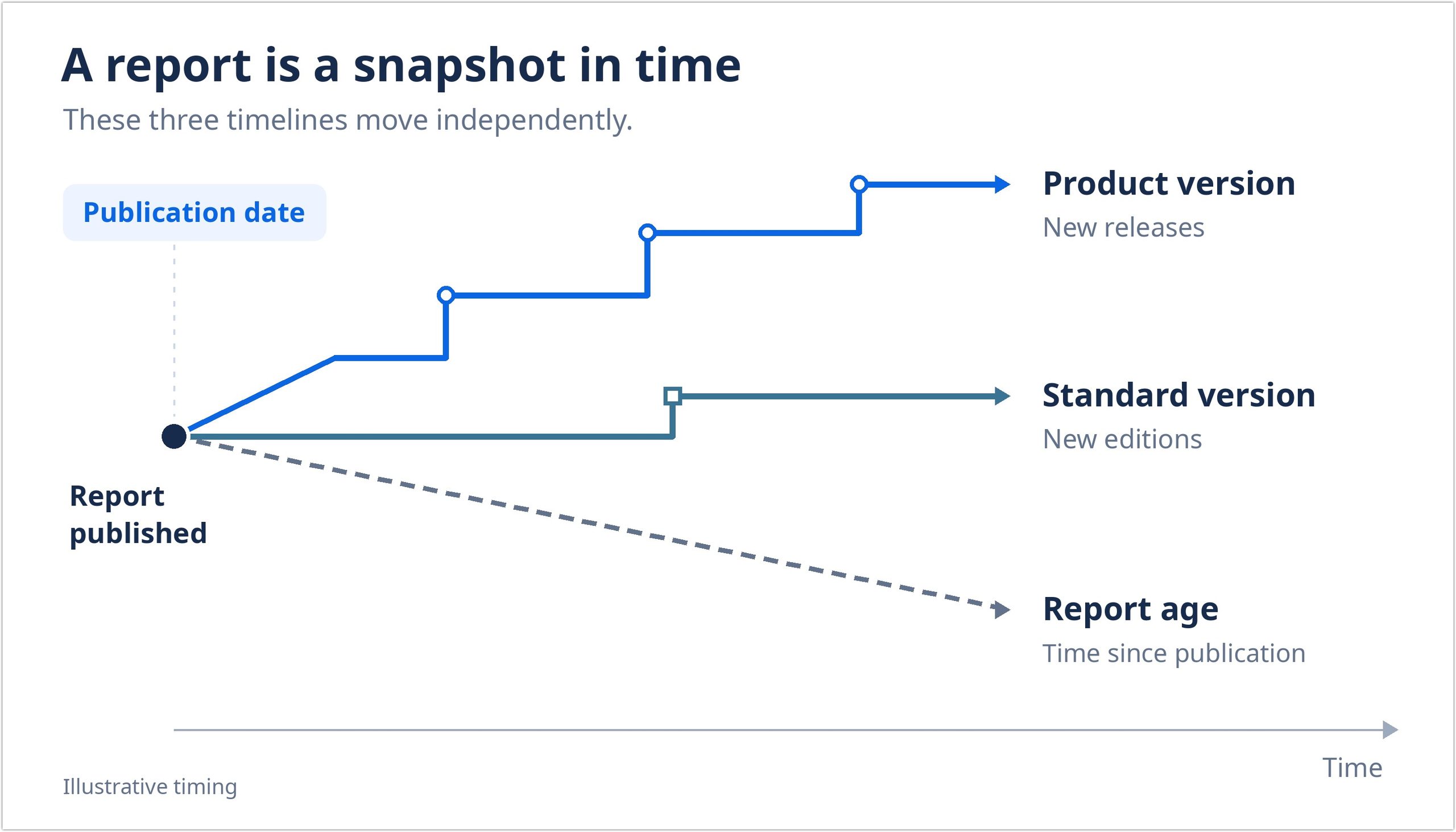
The product changes. You shipped a redesign, and the pages named in the report no longer exist. This is the most common one and the easiest to spot, because the report’s own date gives it away.
The standard moves. This one is harder to see. The International edition of VPAT 2.5Rev covers EN 301 549 at V3.1.1 (2019-11) and V3.2.1 (2021-03), the versions that were current when the template was published.
A newer version, v4.1.1, was published on 2 September 2026. It moves the web baseline from WCAG 2.1 to WCAG 2.2 and adds six success criteria, which we cover in detail in what changed in EN 301 549 v4.1.1. The templates do not reference it yet.
That is not a compliance problem today. v3.2.1 is still the version cited in the Official Journal, so it is the one that carries legal weight in the EU.
It does mean a European buyer may ask how you fare against v4.1.1. Saying plainly which version you tested against is better than leaving them to work it out.
The guidance moves, and sometimes lags. Section508.gov’s own page on creating an ACR still tells sellers “The current version of the VPAT is 2.4.” ITI released 2.5Rev in April 2025, and that page carries a review date of June 2026.
The same page adds that “Any VPAT 2.x is acceptable,” so following it will not cost you an award.
The practical answer for all three is on the cover. A reader who has the report date and the product version in front of them can judge whether anything inside still applies.
Neither section508.gov page sets a required update frequency, so the yearly cadence above is a suggestion rather than a rule.
FAQs on VPAT
The VPAT is ITI’s blank template. The ACR is the completed report you get after filling it in for a specific product.
Not for you as a vendor. Section 508 places its obligation on federal agencies, and agencies may accept “other evidence of accessibility testing.” But a federal solicitation will usually require a complete ACR for your bid to be considered.
The product owner or developer. ITI notes that resellers can complete one, but that whoever knows the product best, usually the manufacturer, is best placed to do it accurately.
No. For a report intended to inform US federal procurement, only Levels A and AA are required.
The template itself is free from ITI. If you hire someone, published vendor price lists run from a few hundred dollars for a single edition to around a thousand for the International edition. The underlying audit is priced separately and usually costs more than the document. Those are individual vendors’ list prices rather than a market rate, so treat them as a starting point for quotes.
You can write your own, and most companies do. Third-party review is optional unless a specific customer or agency requires it in the contract.
AUTHOR

Melwyn holds a Bachelor's degree in Computer Science and has been writing professionally for over 4 years. He has a strong background in SEO and is certified in web accessibility from the World Wide Web Consortium (W3C). When he's not writing about website optimisation, you can find him enjoying a game of FIFA or exploring the open world of GTA.
 Safwana
 Melwyn Joseph