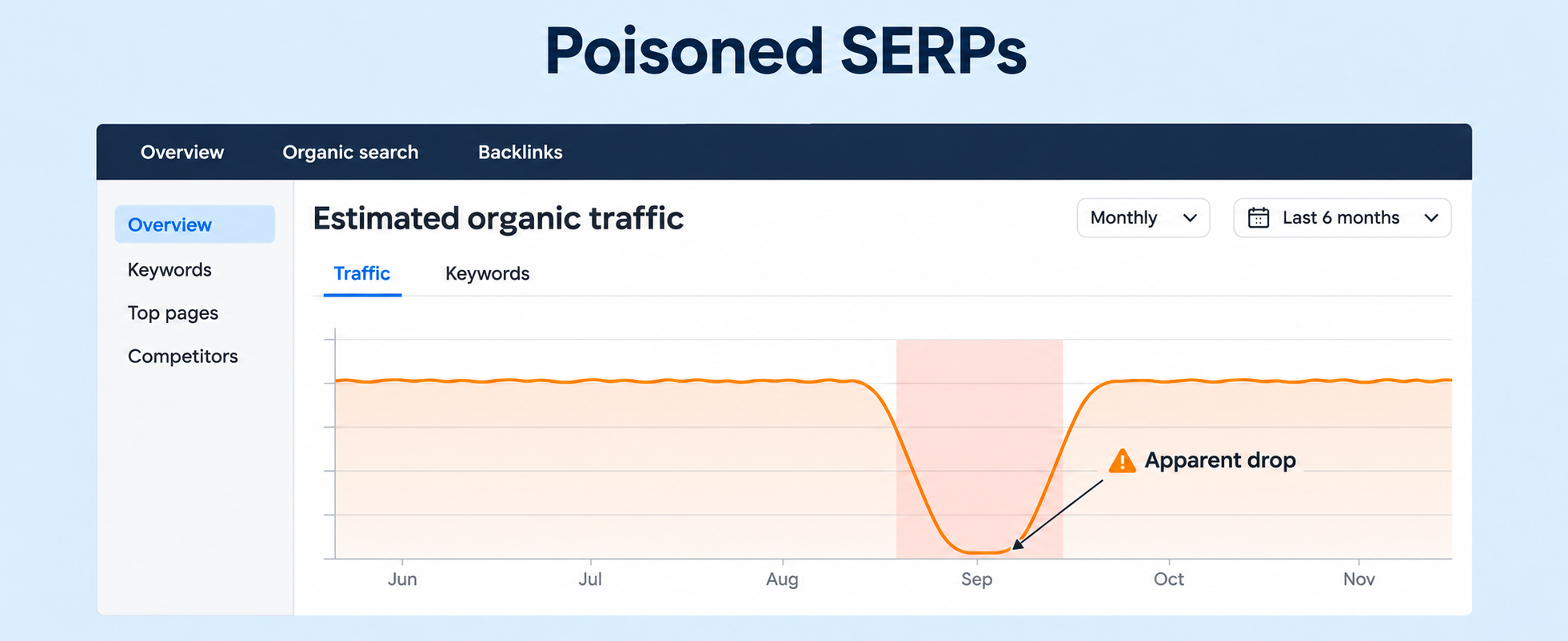
Your rank tracking tool says a keyword fell out of the top 10 overnight. You open Search Console, and the clicks and impressions for that page look exactly as they did last week.
So which one do you believe? Right now, there’s a good chance the answer is Search Console. A rank tracker isn’t a real searcher: it sends thousands of automated queries a day and stores whatever page comes back.
Since mid-September, rank tracking vendors report that Google has started treating many of those automated searches differently. Some are simply blocked, but others get a complete results page with a different set of websites on it, and the tracker records that page as your real position. SEOs now call these poisoned SERPs, and they’re showing up in ranking reports across the industry.
This article covers what poisoned SERPs are, what’s known and what’s still guesswork, how they skew your SEO reporting, and how to tell a real ranking drop from a poisoned one.
What is a poisoned SERP?
A poisoned SERP is a results page Google sends to a suspected bot in place of the page a person would see. The layout looks normal, but the organic listings have been swapped, often for sites that have little to do with the search.
There’s no error message and no CAPTCHA, so the tracker stores the page as if it were real. Derek Perkins of the rank tracker Nozzle put it neatly in his research on poisoned Google SERPs: “A refused request tells a scraper to try again; a poisoned one gets stored as real.”
That’s what makes this different from a normal outage. When a tool is blocked, everyone knows the data is missing. When it’s fed the wrong page, the data looks complete, and the mistake flows into dashboards and reports.
Note: Poisoned SERPs aren’t the same as “SEO poisoning”, the security term for criminals pushing malicious sites into search results. Poisoned SERPs only affect the data that tools collect. Real searchers see normal results.
What we know, and what we don’t
How we got here
Google has been making it harder to scrape its results for some time. Each of these steps hit the tools that collect Google’s results:
- September 2025: Google stopped supporting the
num=100parameter, which rank trackers used to load 100 results in a single request. Search Console impressions dropped for many sites at the same time, which led to speculation that scraping tools had been inflating them. - December 2025: Google took legal action against SerpApi, a company that scrapes and resells Google results, accusing it of “circumventing our security measures”.
- Mid-September 2026: tools started struggling to collect results at all. Barry Schwartz of Search Engine Roundtable reported on 18 September that Google “may be more successful in blocking AI scrapers, search scrapers and third-party tracking tools since around September 13th or so.”
- Shortly after: swapped results began appearing in the data that did get through. SE Ranking’s sample shows a jump on 17 September, while Nozzle’s data shows the rise from 20 September.
According to Perkins, Google has been using three tactics at once: blocking wide ranges of IP addresses, showing more CAPTCHAs, and “injecting bad data into suspect SERPs”. Writing up those findings, Schwartz said: “The third approach, injecting bad data, concerns me the most.”
Which tools have acknowledged it
This isn’t one vendor’s theory. Ahrefs, Semrush, SE Ranking, AccuRanker, BrightLocal, and SEOmonitor have all acknowledged it, and most say they now filter out suspect results. Ahrefs calls it “an industry-wide issue”, and Semrush says some automated requests “may return results pages that appear normal but differ from what a typical user would see.”
What’s missing is a word from Google. As of late November 2026, Google hasn’t commented publicly on poisoned SERPs, so everything about its motives is inference.
How widespread is it?
It depends on who you ask, and on what they’re measuring. Each tool counts something slightly different, so the figures below can’t be compared directly.
| Source | Figure | What it measures |
|---|---|---|
| Nozzle (data to 3 Nov 2026) | 27.6% of searches (68.6% on the worst day, 2 November) | Share of the searches Nozzle ran where page 1 or page 2 came back poisoned, averaged since 13 September. Before that date it was 0.28%. Page 1 alone: 15.0% of searches |
| Ahrefs (22 Oct, updated 6 Nov) | 5% to 20% of results | Share of the search results Ahrefs collected that were poisoned, depending on which data provider supplied them. By 6 November, Ahrefs said page 1 data was “largely recovered and stable” |
| SE Ranking (3 Nov) | 57.3% of keywords | Share of keywords in a 10,000-keyword US sample that showed unrelated results on 17 September, up from 0.09% the day before |
| AccuRanker (via Search Engine Journal) | 30.2% of results, falling to 0.58% | Share of desktop results AccuRanker’s checks flagged as suspect, on 25 September and then on 17 October |
The sources also disagree on where it happens. BrightLocal says the effect “shows up on page 2 and beyond”, while Nozzle finds page 1 affected too, though page 2 is poisoned one and a half times as often.
Why would Google do this?
Nobody outside Google knows for sure. One widely shared explanation is that it’s aimed at AI companies that scrape Google’s results to feed their own products, with rank trackers caught in the crossfire. Semrush says industry discussion “suggests a likely driver is the effort to limit large-scale data collection for AI systems.”
Others go further. SISTRIX has suggested the changes may be about limiting competitors such as ChatGPT, according to PPC Land, and Search Engine Journal’s Roger Montti thinks it may also be a way to confound spammers. Until Google says something, treat all of these as theories.
How poisoned SERPs affect your SEO reporting
If you use a rank tracker, or report on rankings for clients or stakeholders, poisoned SERPs can distort your numbers in several ways.
- Drops that never happened. Nozzle found that a tracked site was missing from the top 10 on 63.7% of poisoned searches, against 2.6% before. One bad collection can make a stable keyword look like it crashed.
- Lower visibility scores. Every poisoned batch drags down visibility and share-of-voice metrics, which can look like a sitewide decline when nothing changed.
- Misleading competitor research. On a poisoned page, the sites that “outrank” you may not appear for real searchers at all, so a competitor can seem to jump overnight. Nozzle found poisoned pages kept only 30.0% of the sites from the previous check, against 88.2% before, with social platforms, Facebook most of all, filling many of the gaps.
- Deeper positions hit harder. SE Ranking found the unrelated results started at position 9 or lower in 96.5% of cases, so lower positions, especially on page 2, are the most likely to swing.
- Reports already sent. Agency and client reports from late September and October 2026 may show drops that searchers never saw.
The tricky part is that a poisoned page doesn’t look poisoned. SEO consultant Lily Ray summed up the mood on 8 October: “Trying to share some findings on this but rank trackers are too unreliable at the moment.”
How to tell a real drop from a poisoned one
Perkins sums up the challenge: “Nothing on the page gives it away. Each keyword’s own history does.” These checks, roughly in order, will tell you most of what you need.
- Check Search Console first. Open the Performance report, filter by the query and the page, and compare clicks, impressions, and average position with the previous weeks. Search Console reflects what real searchers saw, so if those numbers are steady, your ranking most likely is too.
- Look at weeks of history, not yesterday. A keyword that sat at position 4 for months and suddenly shows position 40 for one day is the pattern to watch for. A real drop should show up across several checks and stay.
- Wait and recheck. Poisoned results usually clear on their own. Nozzle found the usual sites were back within three days on 45.1% of poisoned searches, and within two weeks on 89.0%.
- Look at the whole results page. If your tracker keeps a snapshot of the page it recorded, open it, and be suspicious if most of the sites listed have nothing to do with the topic. SE Ranking found that in 84% of cases, the unrelated results matched just one word of the search, such as “line” for “business bank line of credit”.
- Check page 2 separately. Since page 2 is poisoned more often than page 1, a keyword that slips from page 1 to page 2 deserves a closer look before you act on it.
- Search for it yourself, if it really matters. Use a private browser window and remember that results vary by location and device, so this is a sense check rather than proof.
Tip: Before you report a big ranking drop, check the same query in Search Console. If clicks and impressions haven’t moved, wait a few days and look again before you change anything on the page.
What to change in your SEO reporting
You don’t need to stop using rank trackers. You just need to stop treating a single day’s ranking as fact.
- Make Search Console your main source for your own site. It’s built from real searches, so poisoned SERPs don’t affect it. It isn’t updated in real time, but for reporting on your own pages it’s the most reliable ranking data you have.
- Use rank trackers for trends. Weekly or monthly averages smooth out one-off poisoned results. Single-day movements, especially on page 2, are where the noise is.
- Annotate reports from September 2026 onwards. A short note explaining the industry-wide data issue saves you from defending drops that didn’t happen.
- Cross-check with a second data source. Ahrefs found the share of affected results ranged from 5% to 20% depending on the data provider, so a drop that shows in one tool but not another is a warning sign.
- Ask your tool vendor what it’s doing. Many trackers now filter suspect results and collect them again, but they each do it differently. BrightLocal’s Myles Anderson was frank about it: “There’s no single fix that solves it completely, not for us or for anyone else in the industry.”
- Tell clients and stakeholders before they notice. It’s an easier conversation when you raise it first, with Search Console data to back you up.
When the drop is real
Sometimes Search Console confirms the drop. Clicks and impressions are down, the lower position holds for weeks, and the results page looks normal. Then it’s time to look at your own site.
Google’s November 2026 core update, which started on 10 November, is one possible cause, so compare the timing of your drop with the rollout. On the site itself, rule out technical causes such as indexing changes, server errors, broken redirects, or pages blocked by mistake.
Our step-by-step website audit guide and technical SEO audit checklist walk through what to check. The WebYes website audit flags issues such as broken links, missing meta tags, and slow pages on both mobile and desktop, so you can rule out problems on your side quickly.
The bottom line
Poisoned SERPs are a data problem, not a rankings problem. Real searchers still see normal results, and Search Console still reflects them.
What has changed is how much you can trust a single rank check. Lean on Search Console for your own site, read rank trackers as trends, and check before you react. As Coywolf’s Jon Henshaw put it: “Google is a scraper that doesn’t want to be scraped.”
AUTHOR

Safwana writes about web accessibility and the changing shape of SEO, from WCAG compliance and inclusive design to what it means to build a site that both humans and AI agents can actually navigate and understand. Her work sits at the point where these two worlds meet: making the web more usable for people, and more legible to the AI systems now reading it.
 Melwyn Joseph